
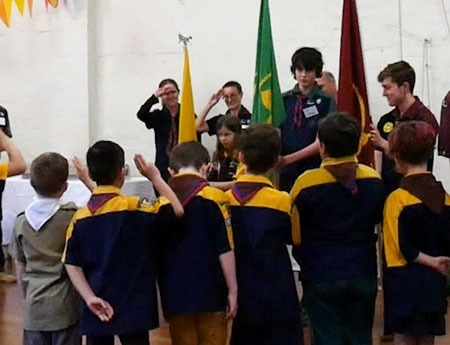
The white scarf is given to boys who have joined the pack and have not yet been invested.
The white scarf can best be explained to the Cub as being like the white paint that is painted on Zulu boys. When a boy was becoming old enough to be a warrior he was taken and stripped of his clothing and painted white all over. He was given a shield to protect himself and an assegai or small spear to kill animals or enemies. He was then turned loose into the bush.
If anyone saw him while he was still white, they would hunt him and kill him. The paint took about a month to wear off—it would not wash off.
So for a month the boy had to hide in the jungle, living as best as he could.
He had to follow the tracks of the deer, creep near enough to spear the animal in order to get food and clothing. He had to make fire to cook his food by rubbing two sticks together—he had no matches. He had to be careful not to let his fire smoke too much or it would catch the eye of the scouts on the lookout to hunt him.
He had to be able to run long distances, to climb trees and to swim rivers in order to escape from his pursuers. He had to be brave and stand up to a lion or any other wild beast.
He had to know which plants were good to eat and which were poisonous and how to cook them. He had, of course, to make his own cooking pots out of the bark of trees or clay. He had to build a hut to live in, remembering to keep it well hidden,
He had to take care that wherever he went, he left no foot tracks by which he could be followed. If he snored when he was asleep, it would give him away to a keen-eared enemy. So he learned to keep his mouth shut and breath quietly through his nose.
When the white paint had worn off, he was able to return to his village and amid much rejoicing, he was allowed to take his place among the young warriors of the tribe.
The white scarf on a Cub means that he is learning to become a Cub by learning and living by the Law and Promise. Then, when he is ready, about a month or six weeks, he is invested and given a Group scarf.
During his life as a Cub, he will acquire attitudes and skills which may be the basis of all future development.
Remember our founder set a programme to embody flexibility and the use of boy centred activities.
Our obligation is to see Cubbing through the eyes of the boy—it is not so much what you can do for a Cub in his Pack life, but what you guide him to do for himself that counts.
When you stop learning—you stop leading.
Source: unknown.
 1st Leichhardt Scouts